
The Power of the Peer Group: Why Montessori Mixed-Age Classrooms Matter
One of the most distinctive features of Montessori classrooms is the three-year age span (typically ages 6 to 9 in a Lower Elementary Classroom ). While most schools separate children into single grades
based on their birth year, we believe that a diverse "mini-society" is a far more effective way to prepare
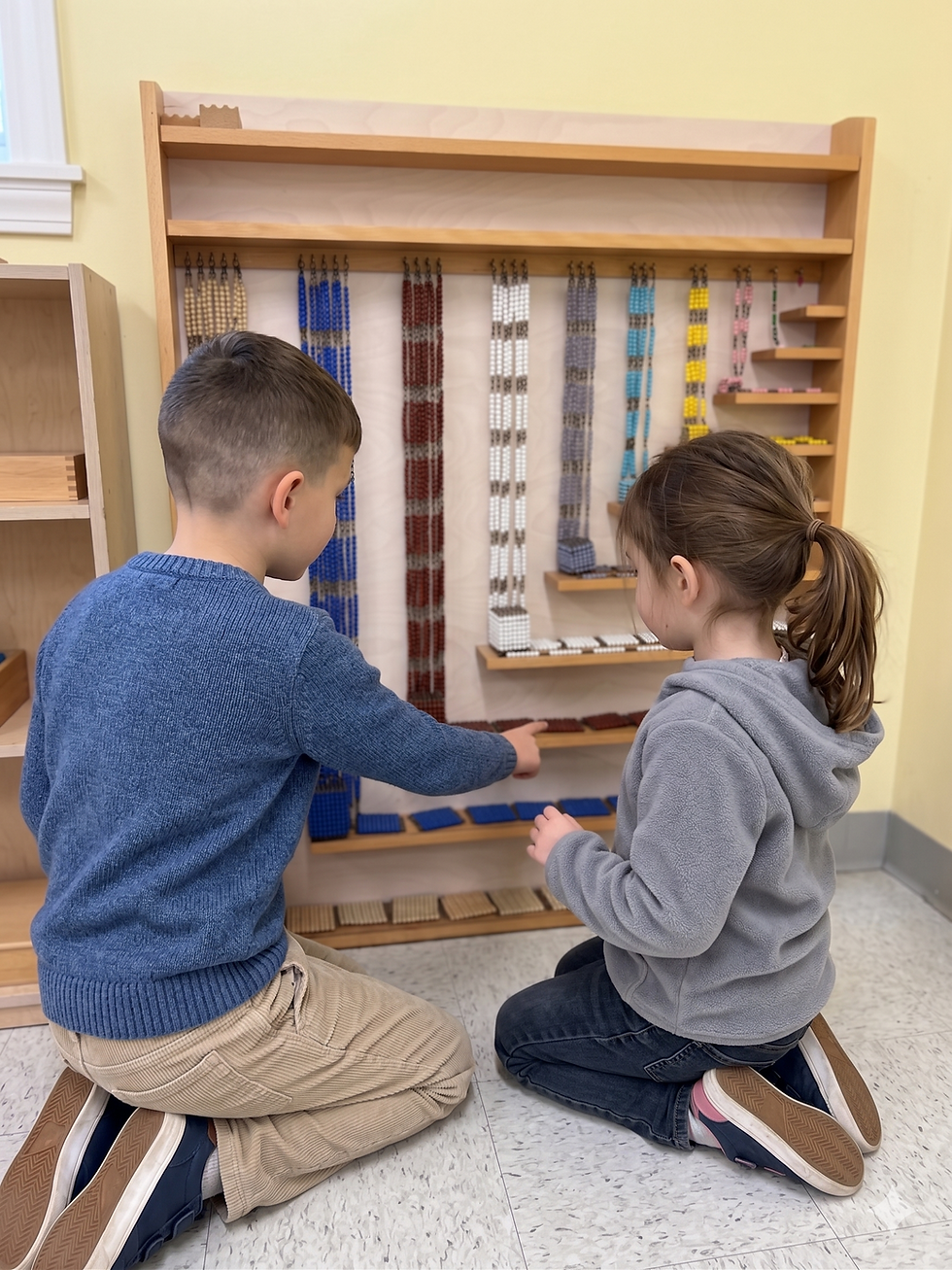
children for the real world.
The Three-Year Cycle of Mastery
In a traditional grade-level classroom, the social pressure to be "at level" with everyone else is immense. In a mixed-age Montessori classroom, that pressure is replaced by a natural cycle of mentorship:
The Novice (Year 1): As the youngest in the room, 6-year-olds are surrounded by role models. They see the sophisticated research and complex math the older children are doing and are naturally pulled toward higher levels of achievement.
The Collaborator (Year 2): With a year of experience, these students become the "connectors" in the room, working fluently with both older and younger peers.
The Mentor (Year 3): This is the "capstone" year. When an 8-year-old teaches a 6-year-old how to use a math material or how to structure a sentence, they are performing a high-level cognitive task. Teaching a concept is the ultimate proof of mastery—if you can explain it to someone else, you truly own the knowledge.
Curious how this looks in action? We'd love to show you.
Social-Emotional Stability
Because students stay with the same teacher and peer group for three years, the "getting to know you" phase that eats up the first month of traditional school is eliminated. The teacher knows exactly where each returning child is academically and socially, allowing for a seamless transition into deep work every September.

What to Look for on Your Tour
As you walk through Franklin, you will notice the vibrant activity in our Primary (ages 3–6) mixed age classrooms. When you step into the new Lower Elementary classroom, look for the Transition Materials: Ask your guide to show you the materials that exist in both the Primary and Elementary rooms, such as the Golden Beads. You can see how the materials a child used as a 4-year-old to learn "ten" are the same ones they will use as an 8-year-old to master "thousands." This continuity is why the mixed-age model works so well—it provides a stable, familiar foundation that allows children to take big social and academic risks. Even before the first class begins, you can see how the room is set up to support a 6-year-old novice and an 8-year-old mentor simultaneously.


